
Is JavaScript hard to learn? The parts that actually are

Tien Nguyen
· 7 min read
Is JavaScript hard to learn? Here’s the honest answer: it is one of the easiest languages to start and one of the trickier ones to master, and the parts that make it hard are specific and nameable. Most answers stop at “it has quirks.” The real ones have names: the event loop, the this keyword, closures, prototypes, and type coercion. Learn those, and JavaScript stops feeling random.
There is also a 2026 shift the older answers predate. AI assistants make starting JavaScript easier than ever, because they will write working code for you on day one. But that widens the gap between code that runs and code you understand, and the hard parts above are exactly the ones you have to understand to debug what an AI wrote. So JavaScript is arguably easier to start and more important than ever to actually learn.
Is JavaScript hard to learn, or not?
Both are true, and the line between them is specific. Starting is genuinely easy. JavaScript runs in every browser with zero setup, gives you instant visual feedback, and forgives small mistakes instead of refusing to run. You can build something real in your first week, which is why it is one of the most recommended first languages.
Mastering it is where it gets hard, and the reason is a paradox: the same forgiveness that makes JavaScript easy to start lets you write code that works by accident. It runs, so you assume you understand it, right up until it breaks in a way that makes no sense. What actually trips people up is a small, specific set of concepts. They stay invisible until they cause a bug, which is what makes them feel hard.
What are the hard parts of JavaScript?
Here is what “hard to master” actually means, named concretely. I have watched all six of these trip up beginners, and lately trip up experienced developers debugging code an AI wrote for them. Almost every confusing JavaScript bug traces back to one of them.
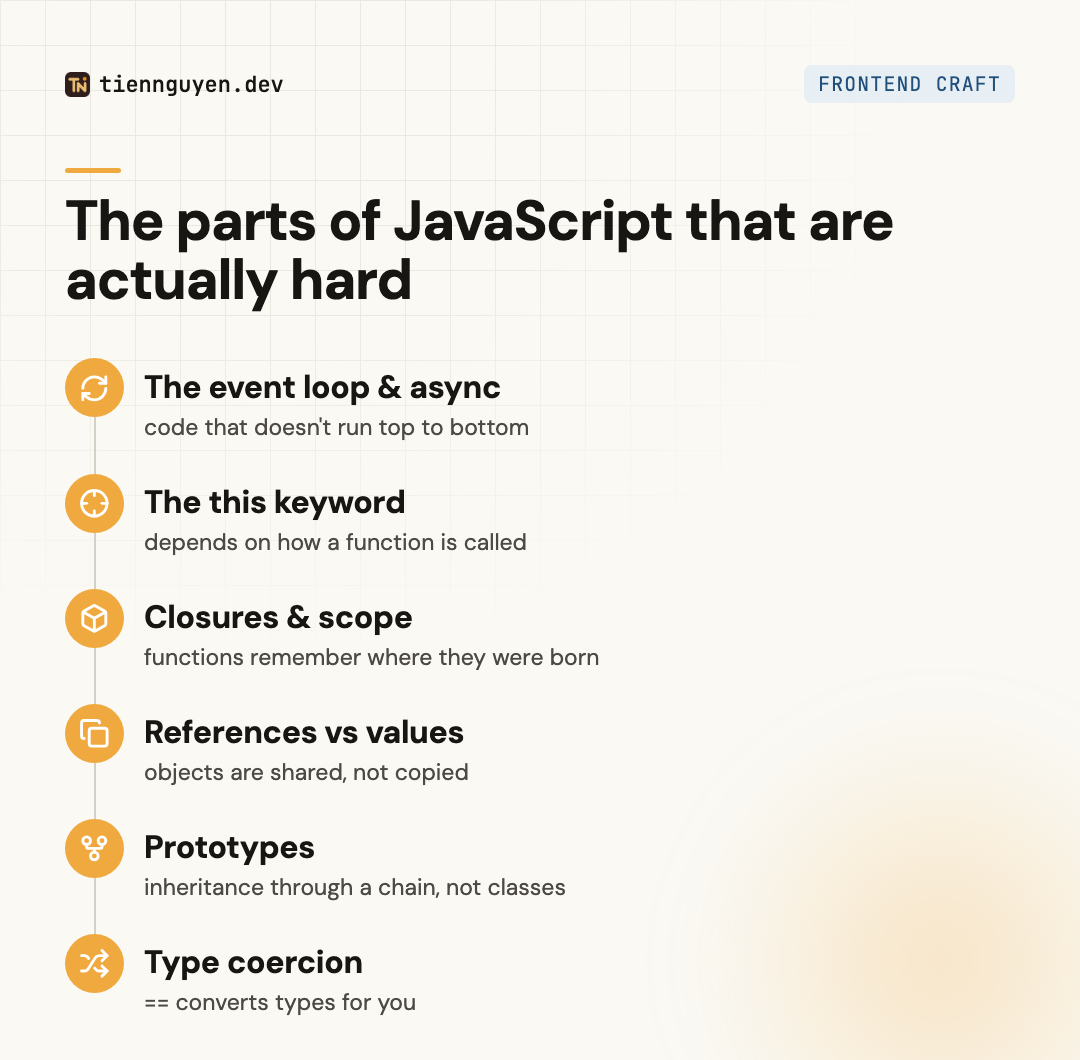
The event loop and async code. JavaScript does not always run top to bottom. This surprises everyone the first time:
console.log('1');setTimeout(() => console.log('2'), 0);Promise.resolve().then(() => console.log('3'));console.log('4');// logs 1, 4, 3, 2 — not 1, 2, 3, 4The synchronous lines run first, then queued microtasks (promises), then timers. Understanding why is the difference between using async/await confidently and cargo-culting it.
The this keyword. What this points to depends on how a function is called, not where it is defined, which is the opposite of most languages. It is the single most asked-about part of JavaScript, and I break down all of its rules in the this keyword, actually explained.
Closures and scope. Functions remember the variables from where they were created, even after that scope is gone. It powers private state and half of React’s bugs, and it is worth understanding deeply: see closures in JavaScript.
References vs values. Objects and arrays are passed by reference, so copying one and changing it can change the original. This is behind a whole class of “why did that change?” bugs, especially in state: shallow copy vs deep copy covers it.
Prototypes and the prototype chain. JavaScript does inheritance through a chain of prototype objects, not classes (the class keyword is syntax over the same mechanism). You can go far without touching it, then hit a wall when you need to understand how objects actually resolve properties.
Type coercion (and a number surprise or two). JavaScript converts types for you, and does floating-point math like every other language. Both are convenient until they are baffling:
0.1 + 0.2; // 0.30000000000000004 (floating point, not a JS-only quirk)'5' - 1; // 4 ('5' becomes a number)'5' + 1; // '51' (1 becomes a string)[] == false; // true (the coercion rabbit hole)The fix in practice is small (use ===, convert types on purpose, round money), but the mental model takes a while. TypeScript catches some of these before they run, but it compiles to JavaScript, so the runtime behavior is still yours to understand.
Is JavaScript hard for beginners?
No. For getting started, it is one of the friendliest languages there is. The browser is the runtime, so there is nothing to install, and every result is visible immediately. Beginners build real, interactive things fast, which keeps motivation high.
The beginner trap is not the start. It is treating “it works” as “I understand it.” JavaScript will happily run code you do not fully grasp, so the discipline that separates people who learn it from people who stay stuck is refusing to move on from code you cannot explain.
Is JavaScript harder than Python?
Python is usually the gentler start. Its syntax reads closer to English, and it has fewer early surprises. JavaScript front-loads more of its weirdness: you meet coercion, this, and async code sooner than a Python learner meets their equivalents.
But this comparison has a catch that the others do not: JavaScript is the language of the browser. If you want to build for the web, there is no Python substitute for the front end. So the honest answer is that Python is a slightly easier first language, and you will likely learn JavaScript anyway.
Does learning JavaScript with AI make it easier?
In 2026, this part changes the calculus. AI assistants will write working JavaScript for you from day one, which makes the start almost frictionless. The risk is that it makes the hard parts easier to skip, not easier to learn.
You can now generate a working feature without understanding the closure, the this binding, or the async flow inside it. It runs, so it feels like progress. Then it breaks, and debugging code you did not write and do not understand is far harder than writing it yourself would have been. That is comprehension debt, and it comes due at the worst time.
So use AI the way that actually helps: have it explain a hard part five different ways, ask it why an error happened, and have it review code you wrote, rather than pasting code you cannot read. The hard parts above are exactly the ones AI will paper over and exactly the ones you need when its output is wrong. I make the same case for the React layer in is React easy to learn.
The takeaway
Is JavaScript hard to learn? Easy to start, hard to master, and the hard part is a short, specific list: the event loop, this, closures, references, prototypes, and coercion. That is good news, because a nameable list is a study plan, not a fog.
Start building immediately, because the fast feedback is JavaScript’s superpower. But do not let “it works” be the finish line, especially when an AI wrote it. Learn the hard parts one at a time (they each have a real explanation), and then, when you are ready for a framework, how to learn React is the next step. The language underneath is the part that keeps paying off.
Frequently asked questions
Is JavaScript hard for beginners?
No, it is one of the friendliest languages to start. It runs in every browser with no setup, gives instant visual feedback, and forgives a lot of small mistakes, so beginners see results fast. The difficulty comes later, when working code starts behaving in ways you cannot explain. The honest framing is that JavaScript is easy to begin and hard to master, and the trap for beginners is stopping at 'it works' without learning why it works.
Is JavaScript harder than Python?
Python is usually easier to start with because its syntax is cleaner and it has fewer surprises. JavaScript has more quirks a learner hits early: type coercion, the this keyword, and asynchronous code. But JavaScript is the language of the browser, so if you want to build for the web, you learn it regardless of how it compares. They are close in overall difficulty; JavaScript just front-loads more of its weirdness.
Is JavaScript a dying language in 2026?
No. JavaScript still runs virtually every website, and that is not changing. The main shift is that many teams write TypeScript, but TypeScript is JavaScript with types added; it compiles down to JavaScript and you still need to understand the language underneath. Learning JavaScript in 2026 is learning the foundation that TypeScript, React, Node, and every front-end framework are built on. It is the opposite of a dead end.
How long does it take to learn JavaScript?
You can learn the basics (variables, functions, loops, working with the DOM) in a few weeks, and be productive on small projects in a couple of months. Getting genuinely comfortable, where the hard parts like closures, the event loop, and this stop surprising you, usually takes six months to a year of building real things. There is no shortcut through the hard parts; you learn them by hitting the bugs they cause and understanding why.
What is the hardest part of JavaScript to learn?
For most people it is asynchronous code and the event loop: understanding why things do not run top to bottom, and how promises and async/await actually schedule work. Close behind are the this keyword (what it points to depends on how a function is called) and closures (functions remembering the scope they were born in). These are hard because they are invisible until they cause a bug, and they are exactly the parts you cannot skip if you want to debug real code.
Keep reading
Tien Nguyen
· 7 min read
Shallow copy vs deep copy in JavaScript, and the React bug
Shallow vs deep copy in JavaScript: shallow shares nested refs, deep is independent. The React bug it causes, and why structuredClone beats the JSON hack.
Read article
Tien Nguyen
· 8 min read
Closures in JavaScript, and the stale-closure bug in React
What a closure is in plain JavaScript, and the stale-closure bug it causes in React hooks: the one idea behind bugs AI writes and juniors paste unread.
Read article
Tien Nguyen
· 9 min read
The this keyword in JavaScript, actually explained
How the this keyword in JavaScript really works: one mental model (read the call-site), the 4 binding rules, and the callback bug that trips up every dev.
Read articleLiked this? Let's build something.
I take on a small number of front end and AI-engineering projects, and I'm always up for talking shop. Tell me what you're working on.