
How to learn React in 2026: the AI-first roadmap

Tien Nguyen
· 7 min read
Most “how to learn React” guides are a bullet list that hasn’t changed since 2020: learn HTML, learn CSS, learn JavaScript, build a todo app. That’s not wrong, it’s just stale, and it ignores the one thing that actually changed how you learn to code in 2026: AI.
Here’s the honest roadmap. React is more learnable than it has ever been, on one condition: you use AI as a tutor, not a code vendor. Let it explain and review, and you’ll move faster than any generation of beginners before you. Let it write code you can’t read, and you’ll build an app you can’t maintain and mistake that for progress.
For where I’m coming from: I learned React the pre-AI way, from the docs and my own mistakes, shipped it in production, and have since watched a wave of people learn it AI-first instead. The path below is what I’d hand someone starting today, in the order it actually has to go.

What should you learn before React?
Skip this and everything later hurts. React is mostly modern JavaScript with a small API on top, so the prerequisites aren’t optional:
- HTML and CSS well enough to build a static page without looking everything up.
- JavaScript, specifically: variables and functions, arrow functions,
map/filter, destructuring, template literals, promises andasync/await, and ES modules.
That JavaScript list is the real gate. If it feels shaky, fix it first, because React feels like magic you can’t debug when your JavaScript is weak. A lot of “React is hard” is really “JavaScript fundamentals like scope and this are still shaky.” AI makes brushing these up fast, so it’s a days-to-weeks detour, not a months one.
What’s the React learning path, step by step?
Here’s the sequence I’d actually follow in 2026. Each stage builds on the last, so resist the urge to skip ahead.
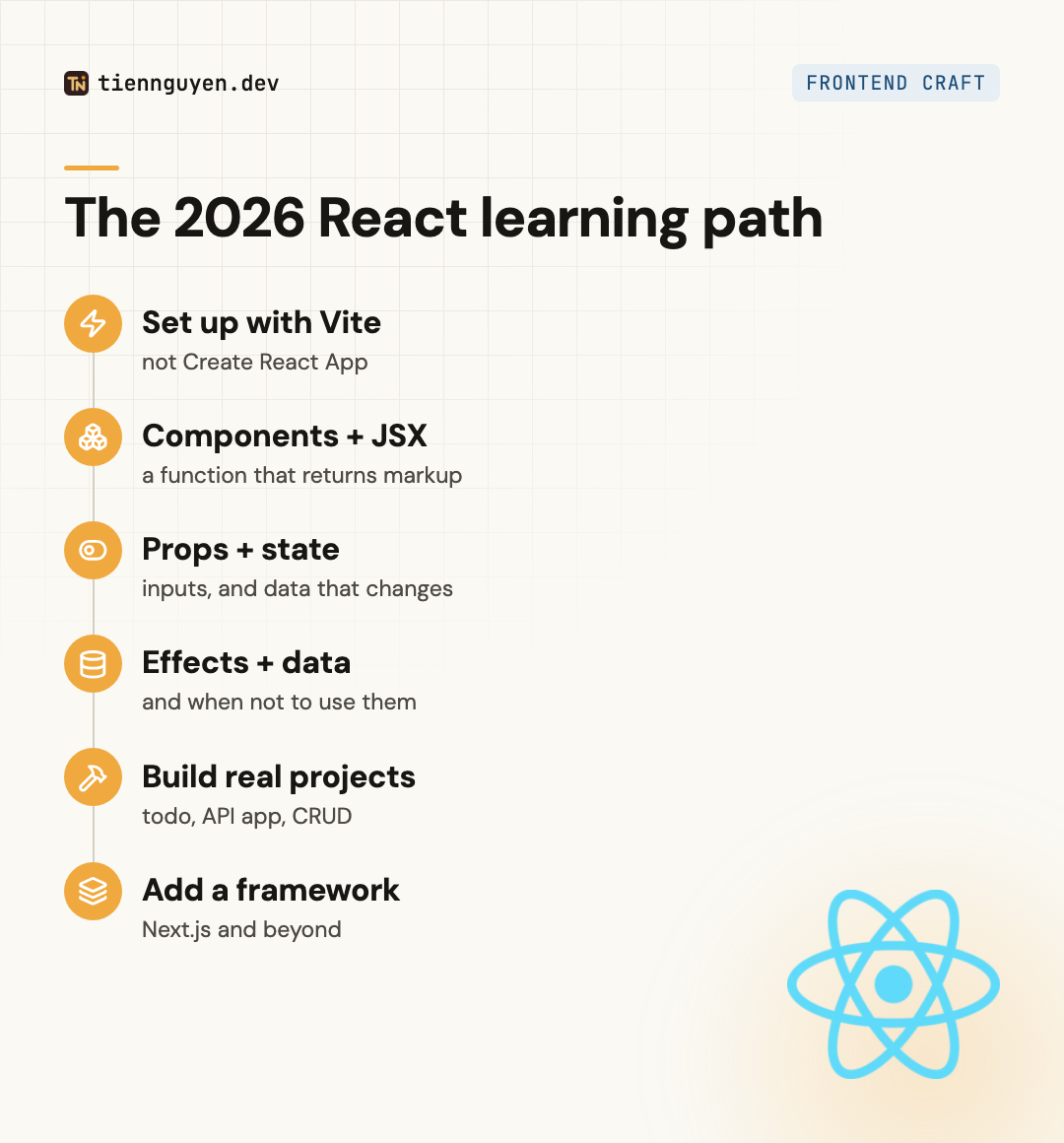
1. Set up with Vite, not Create React App. This is the most common stale advice online. Create React App is deprecated; the current way to start a plain React app (on React 19, the current stable release) is Vite:
npm create vite@latest my-app -- --template react2. Components and JSX. A component is a function that returns markup. This is the whole mental model, and it’s genuinely easy:
function InboxLink({ user, unread }) { return <a href={`/u/${user}/inbox`}>Inbox ({unread})</a>;}3. Props and state. Props are a component’s inputs (the user and unread above). State is data that changes over time, via the useState hook. This is where “thinking in React” starts, and as an app grows, where to keep that state becomes a real decision.
4. Effects and data, carefully. useEffect is where most beginners get hurt. Learn what it’s for: synchronizing with something outside React. Just as important, learn what it’s not for. Modern React steers you away from using effects for data fetching, toward a framework or a data library instead. Learn the hook, then learn when not to reach for it.
5. Build a real project. Reading about hooks teaches you nothing until you’ve shipped a bug with them. This is the stage that actually matters, so it gets its own section below.
6. Add a framework. Once bare React clicks, most real apps use a meta-framework for routing, data, and rendering. That’s the natural next step, covered in the last section.
What should you build to learn React?
You do not learn React by reading. You learn it by building things slightly harder than what you can already do. A ladder that works:
- A todo app. The cliché for a reason: it covers state, lists, events, and conditional rendering in one small surface.
- A weather or search app that calls a real API. Now you’re handling async data, loading and error states, and the parts of
useEffect(or a data library) that actually matter. - A small CRUD app with routing. A few pages, create/read/update/delete against an API. This is roughly the shape of real work, and finishing one means you can genuinely say you know React.
Build each one, then rebuild the todo app from scratch with no help. If you can’t, that’s the honest signal of what you still don’t know.
How should you use AI while you learn React?
This is the part no other roadmap covers, and it’s the whole difference in 2026. AI assistants (Claude, Copilot, ChatGPT) are the best React tutors that have ever existed if you use them right, and a trap if you don’t.
The rule is simple: use AI to understand, not to avoid understanding. At each stage above, that means asking it to explain a concept five ways, to say why an error happened, and to review code you wrote, rather than having it generate components you paste without reading.
The failure mode to avoid has a name.
Comprehension debt: working code you don’t understand.
It’s easy to vibe-code a React app that looks done and hit a wall the moment it breaks. I break down exactly how to avoid it, with a concrete example, in is React easy to learn. For the roadmap, just hold one line: if you can’t explain what the AI wrote, you haven’t learned it yet, no matter how well the app runs.
Will AI replace React? Is it worth learning in 2026?
Both questions have the same answer, and it’s the one the incumbents dodge.
AI won’t replace React. It generates a lot of React now, which means someone still has to design the components, read the output, catch the bugs, and make the calls AI can’t. That someone is worth more when they understand React, not less. AI changed how you write and learn React; it didn’t remove the need for it.
And React is very much worth learning. It has the deepest hiring pool and the widest ecosystem in frontend by a distance: the popular alternatives, Solid and Svelte, sit at a fraction of its install base. When you’re ready for a framework, SvelteKit vs Next.js covers the meta-framework layer React beginners graduate into. The skills transfer even if you later switch.
The bottom line
Learning React in 2026 isn’t the 2020 roadmap with AI bolted on. The prerequisites are the same (real JavaScript first), but the path is faster and the trap is new. Scaffold with Vite, learn components then state then effects, build a ladder of real projects, and use AI to explain and review, never to write code you can’t read.
Do that, and React is more learnable than it has ever been. Once the roadmap feels easy and you’re shipping real apps, the next rung is going from competent to fluent: mastering React when AI writes much of the code. The only way to lose in 2026 is to let the machine write an app you don’t understand and call it learning.
Frequently asked questions
Is React easy to learn?
It's easy to start and hard to master. A component is just a function that returns markup, so the first hour feels great; the wall comes at hooks, state, and the ecosystem. In 2026 AI lowers the syntax barrier but adds a new trap: shipping code you can't explain. I go deep on this in a companion post on whether React is easy to learn.
What is the best way to learn React in 2026?
Learn the JavaScript first, then follow a project-based path: scaffold with Vite, learn components and props, then state and effects, then build real apps. Use an AI assistant as a tutor that explains and reviews, not a vendor that writes code you paste. The best way is the one where you understand every line you ship, because that's the thing that breaks under you later if you don't.
Is React still relevant in 2026?
Yes, clearly. React has the largest ecosystem, the most jobs, and the most learning material of any frontend framework, and the meta-frameworks built on it (Next.js and others) are where a lot of the industry is. AI writes a lot of React now, which makes knowing React more useful, not less: you have to read and fix what it generates.
Can I learn React in 3 hours?
You can learn what a component is in 3 hours. You cannot learn React in 3 hours. Realistically, with solid JavaScript already, expect a few weeks to build simple apps, a couple of months to be productive, and 6 to 12 months of real projects to be comfortable. Anyone selling a 3-hour path is selling the easy first hour and skipping the wall.
Will AI replace React?
No. AI generates React code, it doesn't remove the need for React or for people who understand it. Someone still has to design the components, read the output, catch the bugs, and make the calls AI can't. AI changes how you write React and how you learn it. It doesn't replace the framework or the judgment around it.
Keep reading
Tien Nguyen
· 8 min read
Is React easy to learn? An honest 2026 answer
Is React easy to learn? Yes to start, hard to master, and AI changed the curve. The honest answer, the JavaScript you need first, and how to learn it in 2026.
Read article
Tien Nguyen
· 8 min read
How to master React in 2026 (when AI writes the code)
How to master React in 2026: AI writes competent React now. The render model, re-renders, state architecture, and effects, past the tutorials.
Read article
Tien Nguyen
· 9 min read
React Query vs Redux: the wrong question, and the right one
React Query vs Redux is the wrong question: one is server state, one is client state. Plus the real fight (RQ vs RTK Query) and the pattern AI still writes.
Read articleLiked this? Let's build something.
I take on a small number of front end and AI-engineering projects, and I'm always up for talking shop. Tell me what you're working on.