
SolidJS vs Svelte: same signals, different bet

Tien Nguyen
· 8 min read
Here’s the thing almost every “SolidJS vs Svelte” comparison still gets wrong: it treats them as compiler versus runtime. Svelte compiles your components away, Solid ships a tiny reactive runtime, and that used to be the whole story.
Svelte 5 ended that story. Its new reactivity, runes ($state, $derived, $effect), is a signals system, the same fundamental idea as Solid’s signals. So the old dichotomy has mostly collapsed into a difference of syntax, ecosystem, and philosophy, not reactivity model.
Short version, so you have the answer up front: both are excellent, both are minority frameworks, and for most teams the honest first question is whether to pick either over React at all. Between the two: Svelte for developer experience and the bigger ecosystem, SolidJS for maximum performance with React-style JSX. Now let me show you why.
For context on where I’m coming from: I’ve shipped React in production, and I’ve evaluated both Solid and Svelte closely without shipping either. So treat the React comparison as lived-in, and the Solid-vs-Svelte read as informed evaluation.
 vs
vs
Weren’t these compiler vs runtime? Not anymore
The short answer: they still differ in how you author reactivity, but the underlying model is now the same. Both are fine-grained signals. A signal is a reactive value that knows exactly which parts of your UI read it, so a change updates only those parts, with no virtual DOM diffing anything.
Here’s a counter in each. SolidJS uses a signal you read by calling it:
import { createSignal } from 'solid-js';
function Counter() {  const [count, setCount] = createSignal(0);  return <button onClick={() => setCount(count() + 1)}>{count()}</button>;}
And Svelte 5, where the same signal is a rune the compiler understands:
<script>  let count = $state(0);</script>
<button onclick={() => count++}>{count}</button>
Squint and they’re the same program. Solid’s createSignal is a plain runtime function call. Svelte’s $state is compiler syntax that gets lowered into the same kind of signal machinery at build time. That is the real 2026 distinction: compiler-authored signals vs runtime-primitive signals, not compiler vs runtime.
How does the reactivity actually work in each?
The counter hides the one difference that still matters. Here’s a small search box that filters a list, with a derived value and an effect, in each.
import { createSignal, createMemo, createEffect } from 'solid-js';
function Search(props) {  const [query, setQuery] = createSignal('');  const filtered = createMemo(() =>    props.items.filter((i) => i.includes(query()))  );
  createEffect(() => console.log('results:', filtered().length));
return ( <> <input onInput={(e) => setQuery(e.currentTarget.value)} /> <ul>{filtered().map((i) => <li>{i}</li>)}</ul> </> );}<script> let { items } = $props(); let query = $state(''); let filtered = $derived(items.filter((i) => i.includes(query)));
$effect(() => console.log('results:', filtered.length));</script>
<input oninput={(e) => (query = e.currentTarget.value)} /><ul>{#each filtered as i}<li>{i}</li>{/each}</ul>createMemo and $derived are the same concept. createEffect and $effect are the same concept. The difference is what happens to Search itself.
In Solid, that function body runs exactly once. It sets up the signals and the reactive graph, returns JSX, and never runs again. When query changes, only the memo and the specific DOM nodes that read it update. Svelte compiles the component to targeted DOM instructions with the same outcome. Both avoid React’s “re-run the whole component and diff a virtual DOM” model entirely, which is most of why both sit near hand-written performance.
The authoring difference is real, though. Solid is JSX, so if you come from React the syntax is instantly familiar (with one gotcha: you don’t destructure props, because that would break reactivity). Svelte is its own single-file .svelte format with {#each} blocks and template directives. That is the actual day-to-day choice now: familiar JSX, or Svelte’s more compact template language.
Is SolidJS faster than Svelte?
Marginally, and probably not in a way you will feel. On the js-framework-benchmark, Solid consistently sits in the top tier right next to vanilla JavaScript, with Svelte 5 a hair behind. Both are within a few percent of hand-written DOM code, and both beat React on the geometric mean.
Bundle size tells the more interesting story, and it’s where the compiler-vs-runtime history still shows. Solid ships a small fixed reactive runtime: the solid-js core is about 8 KB gzipped. Svelte compiles components to imperative DOM code, so its baseline is near-zero and grows per component instead. For the same benchmark app, the brotli-compressed JavaScript comes out close:
| Framework | Compressed app JS |
|---|---|
| vanilla JS | ~1.85 KB |
| SolidJS | ~2.58 KB |
| Svelte | ~2.88 KB |
| React | ~4.41 KB |
Both land at roughly half of React and just above vanilla. The takeaway isn’t “Solid wins by 0.3 KB.” It’s that at this tier, framework runtime is not your performance problem. Your data fetching, images, and third-party scripts are. Pick on ergonomics and ecosystem, because the performance is a wash for anything short of an extreme UI.
How niche are SolidJS and Svelte, really?
Here’s the part the framework-fan comparisons soften. Both of these are minority frameworks, and it’s not close to React.
Weekly npm downloads (mid-2026): Svelte pulls roughly 5.3 million to SolidJS’s 2.7 million (npm trends). Svelte is about double Solid, and has a bigger community, more component libraries, and a more developed ecosystem. But both are dwarfed by React’s ~146 million: that’s about 27x Svelte and 54x Solid.
On meta-frameworks, both are real: SolidStart reached 1.0 in 2024, and SvelteKit is the more mature option (I covered SvelteKit in depth in SvelteKit vs Next.js). For a team that has to hire and reach for off-the-shelf pieces, Svelte is the safer of the two, and React is safer than either.
SolidJS vs Svelte at a glance
| SolidJS | Svelte | |
|---|---|---|
| Built on | a small runtime + JSX | a compiler + .svelte files |
| Reactivity | signals (createSignal) | runes ($state), also signals |
| Syntax | JSX (React-like) | .svelte single-file template |
| Virtual DOM | none | none |
| Component re-runs | never (body runs once) | never (compiled to targeted updates) |
| App bundle (benchmark) | ~2.6 KB | ~2.9 KB |
| Performance | top tier, near vanilla | just behind, near vanilla |
| Meta-framework | SolidStart (1.0) | SvelteKit |
| npm weekly downloads | ~2.7M | ~5.3M |
| Ecosystem / hiring | smaller | larger, still niche |
| Best for | max perf + JSX | DX + the bigger ecosystem |
When should you pick SolidJS over Svelte?
Skip the diplomatic “it depends.” Here’s the rubric I’d actually use.
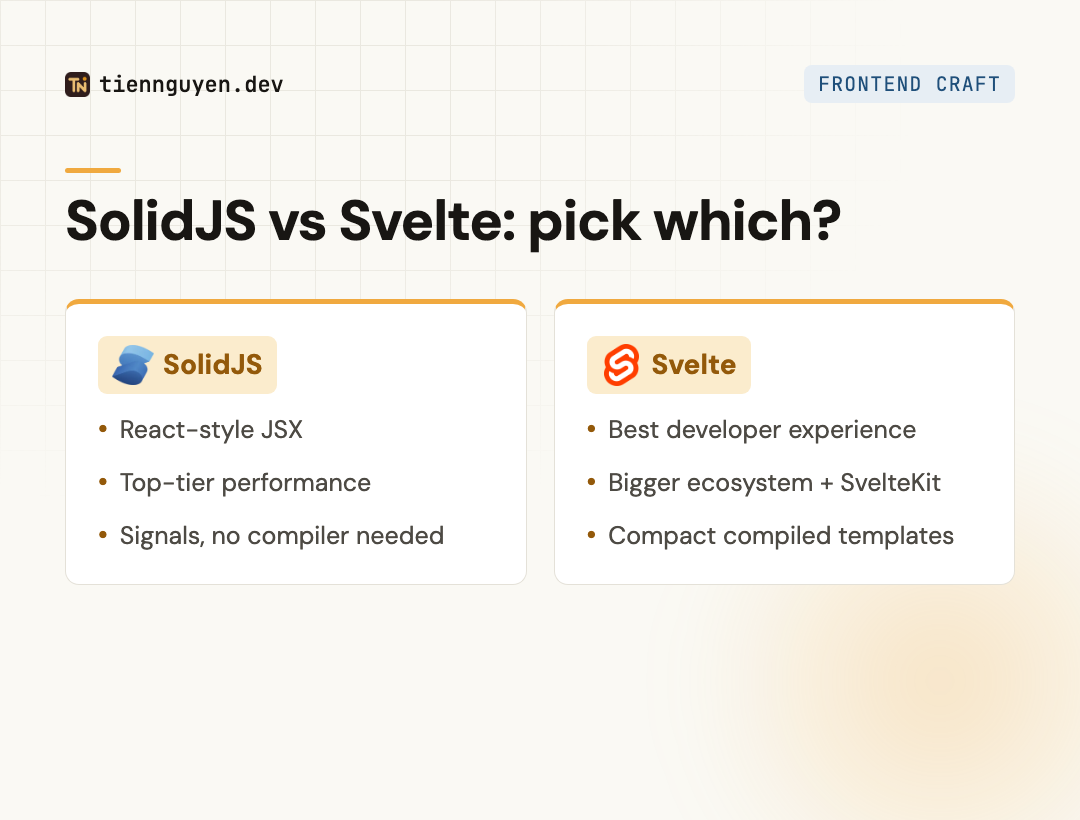
Pick SolidJS when:
- You want React-style JSX and a mental model close to React, without React’s re-render cost.
- You’re chasing the top of the performance charts on a genuinely demanding UI.
- You like signals as an explicit runtime primitive you can pass around and compose, no compiler required.
Pick Svelte when:
- Developer experience and shipping speed matter most (less ceremony, scoped styles, compact templates).
- You want the larger of the two communities and ecosystems, and SvelteKit’s maturity.
- You’re happy to learn a dedicated template syntax in exchange for how little you have to write.
Where each bites you: SolidJS’s failure mode is its small ecosystem and the reactivity gotchas (don’t destructure props, mind when things are tracked). Svelte’s is that its template syntax is one more thing to learn, and even as the bigger niche framework, the hiring pool and library breadth are thin next to React.
The takeaway
The old “compiler vs runtime” framing for SolidJS vs Svelte is mostly retired. Svelte 5 made both signals-based, so the real decision is syntax (JSX vs .svelte), ecosystem size, and taste. Solid is the purist’s signals framework with React-familiar JSX and a hair more performance. Svelte is the friendlier, better-supported one, and the safer pick of the two.
But the biggest question is the one above both of them: for most teams, React still wins on ecosystem and hiring, and you should reach for Solid or Svelte when you have a real reason, not a benchmark you won’t feel. When you do have that reason, you now know which bet is which.
Frequently asked questions
Are Svelte 5 runes the same as SolidJS signals?
Conceptually, yes. Both are fine-grained signals: a reactive value that tracks exactly what reads it and updates only that, with no virtual DOM. The difference is authoring, not model. Solid's signals are plain runtime function calls (createSignal), while Svelte 5's runes ($state) are compiler syntax that gets lowered into the same signal machinery at build time. Same idea, different way of writing it.
Is SolidJS faster than Svelte?
Marginally, and probably not in a way you'll feel. On the js-framework-benchmark, Solid sits a hair ahead, right next to hand-written vanilla JS, with Svelte just behind. Both are within a few percent of raw DOM code and both beat React on the geometric mean. For almost any real app, your data fetching, images, and network dominate the numbers long before the framework runtime does.
Is SolidJS worth learning in 2026?
As a way to understand fine-grained reactivity, yes. It's the cleanest expression of signals with familiar JSX. As a career or ecosystem bet, be honest with yourself: both Solid and Svelte are minority frameworks next to React, and Solid is the smaller of the two. Learn it for the ideas and for greenfield perf-sensitive work, not because you expect a job market.
SolidStart vs SvelteKit: which is more production-ready?
Both are 1.0-plus and genuinely production-capable. SvelteKit is the more mature of the two, with a larger community, more integrations, and more sites running it. SolidStart hit 1.0 in 2024 and is stable, but its ecosystem is thinner. If you're picking a meta-framework for a team today, SvelteKit is the safer bet on ecosystem depth alone.
Should I pick SolidJS or Svelte over React?
Only if you have a specific reason: a perf-critical UI, a hard bundle budget, a greenfield project, or a team that just prefers the DX. React's ecosystem and hiring pool dwarf both. Between the two, pick Svelte for developer experience and the bigger of the two ecosystems, and SolidJS if you want maximum performance with React-style JSX.
Keep reading
Tien Nguyen
· 11 min read
Svelte vs Next.js: which should you actually use?
Svelte vs Next.js is the wrong fight. The fair comparison is SvelteKit vs Next.js. Here's how they really differ, and how to pick the right one.
Read article
Tien Nguyen
· 7 min read
Is JavaScript hard to learn? The parts that actually are
Is JavaScript hard to learn? Easy to start, hard to master. The hard parts are specific (the event loop, this, closures, coercion), plus the AI-era catch.
Read article
Tien Nguyen
· 9 min read
React Query vs Redux: the wrong question, and the right one
React Query vs Redux is the wrong question: one is server state, one is client state. Plus the real fight (RQ vs RTK Query) and the pattern AI still writes.
Read articleLiked this? Let's build something.
I take on a small number of front end and AI-engineering projects, and I'm always up for talking shop. Tell me what you're working on.