
Svelte vs Next.js: which should you actually use?

Tien Nguyen
· 11 min read · updated Jul 3, 2026
Here’s the thing almost every “Svelte vs Next.js” comparison gets wrong before it even starts: it’s comparing a UI library to a full framework. Svelte is a component library that compiles your code. Next.js is a batteries-included React framework with routing, server rendering, and data loading. They don’t sit at the same layer.
The fair fight is SvelteKit vs Next.js. SvelteKit is Svelte’s meta-framework, the actual peer to Next.js. Once you line those two up, the comparison gets clear fast.
Short version, so you have the answer up front: for most teams, pick Next.js for the ecosystem and the hiring pool. Pick SvelteKit when you’re small, perf-sensitive, or you just want to enjoy your day. Now let me show you why. For context on where I’m coming from: I’ve shipped several Next.js apps to production, and I’ve evaluated SvelteKit closely without shipping it. So treat the Next.js gripes as lived-in, and the Svelte take as informed rather than battle-tested.
 vs
vs
First, untangle the three things people conflate
This trips up the whole conversation, so it’s worth 20 seconds:
- Svelte is a UI library and a compiler. You write components, it compiles them to small, efficient JavaScript. No virtual DOM ships to the browser.
- SvelteKit is the framework built on Svelte: routing, SSR/SSG, data loading, API routes. This is the Next.js peer.
- Next.js is the framework built on React: routing, SSR/SSG, data loading, API routes, React Server Components.
So when someone types “svelte vs next js,” the honest answer is: you’re really asking SvelteKit vs Next.js, and underneath that, Svelte’s compiler model vs React’s runtime model. Everything else follows from those two.
What’s the core difference between Svelte and Next.js?
React (and therefore Next.js) ships a runtime to the browser. Your components run against React’s reconciler and a virtual DOM at runtime. Svelte does the work at build time instead: the compiler turns your component into imperative DOM updates, so there’s no virtual DOM being diffed in the browser. (Svelte 5’s runes do add a small signals-based reactivity runtime under the hood, but there’s still no virtual DOM to reconcile.)
You feel it first in the code. Here’s a counter in Svelte 5, using runes (its current reactivity model):
<script>  let count = $state(0);</script>
<button onclick={() => count++}>  clicked {count} times</button>
And the same thing in React, the way you’d write it in a Next.js client component:
'use client';import { useState } from 'react';
export function Counter() {  const [count, setCount] = useState(0);  return (    <button onClick={() => setCount(count + 1)}>      clicked {count} times    </button>  );}
Both are fine. But notice Svelte has no import, no hook, no setter, no 'use client' directive. State is just a variable marked reactive. That “closer to plain JavaScript” feeling is the single most consistent reason people fall for Svelte, and it holds up beyond toy examples.
Is Svelte really faster than Next.js?
Svelte’s compiler model means less framework code ships, so a small Svelte app usually has a smaller initial bundle and fast updates without a virtual DOM. For a content site, a widget, or anything where you’re fighting for every kilobyte on a slow connection, that’s a real, measurable edge.
The honest caveat: at application scale, the framework runtime is often not your bottleneck. Your data fetching, your images, your third-party scripts, and your hydration strategy usually dominate the numbers long before React’s runtime does. Svelte’s bundle win is real, but it’s a bigger deal for a landing page than for a 200-route dashboard. Don’t pick a framework for a benchmark you won’t feel.
Which has better developer experience, SvelteKit or Next.js?
This is where SvelteKit genuinely shines. Less boilerplate, scoped styles in the component by default, and reactivity that reads like assignment. Most engineers get productive in it quickly, and juniors especially tend to find it less intimidating than React’s hooks-and-dependency-arrays mental model.
React earns its complexity in the other direction: the hooks model, once it clicks, scales to enormous apps and an army of engineers who all share the same patterns. It’s more ceremony for a small thing and more leverage for a large one.
How do SvelteKit form actions compare to Next.js Server Actions?
The difference is philosophy. SvelteKit keeps the read and the write in separate, explicit exports (a load function and named form actions, with the page just rendering); Next.js co-locates them inside the component tree. Here’s the same feature, loading a list and adding to it through a form, in each.
In SvelteKit, the route’s server file holds both a load function and named form actions:
export async function load() {  return { posts: await db.getPosts() };}
export const actions = {  create: async ({ request }) => {    const data = await request.formData();    await db.createPost({ title: data.get('title') });  },};
The page reads the data from props and posts the form back to that named action. use:enhance upgrades it to a no-reload submit, with a graceful fallback if JavaScript is off. By default it re-runs load after a successful submit, so the list refreshes without you calling anything, the SvelteKit equivalent of Next’s explicit revalidatePath:
<script>  import { enhance } from '$app/forms';  let { data } = $props();</script>
{#each data.posts as post (post.id)}  <h2>{post.title}</h2>{/each}
<form method="POST" action="?/create" use:enhance>  <input name="title" />  <button>Add post</button></form>
Next.js uses an async Server Component for the read and a Server Action for the write. The action is a function marked 'use server', passed straight to the form, and it refreshes the list with an explicit revalidatePath:
import { revalidatePath } from 'next/cache';
async function createPost(formData: FormData) {  'use server';  await db.createPost({ title: formData.get('title') as string });  revalidatePath('/blog');}
export default async function Page() {  const posts = await db.getPosts();  return (    <>      {posts.map((post) => (        <h2 key={post.id}>{post.title}</h2>      ))}      <form action={createPost}>        <input name="title" />        <button>Add post</button>      </form>    </>  );}
Both approaches hold up well, and both give you progressive enhancement with no client-side fetch boilerplate. Next.js’s co-location is more powerful and more magical. The client/server boundary, when code re-runs, the caching, that magic is exactly what the next section is about.
The 2026 state: Svelte 5 runes vs Next.js App Router
The comparison changed on both sides recently, and most articles haven’t caught up.
Svelte 5 introduced runes ($state, $derived, $effect), a rewrite of its reactivity. It made reactivity explicit and consistent instead of relying on the old compiler-magic $: label. It’s more to learn than Svelte 4, but it’s more predictable, and it closes the gap with React on “you can see exactly what’s reactive.” Those runes are signals under the hood, which is why the old Svelte-vs-Solid comparison changed. I dig into that in SolidJS vs Svelte.
Next.js leaned hard into the App Router and React Server Components. Server Components are a genuinely good idea (less JavaScript to the client, data fetching next to the component), but the App Router also brought real footguns: a caching model that surprised me more than once, the client/server boundary you have to hold in your head, and error messages that assume you already understand RSC. Powerful, but not simple.
That’s the actual 2026 tradeoff: Svelte 5 made a good model more explicit; Next.js made a powerful model more complex. If simplicity is what you value, that gap widened in Svelte’s favor. If you need what RSC gives you, Next.js is still the only one shipping it.
Why is Next.js’s ecosystem still the bigger moat?
Here’s where it stops being close. React’s ecosystem is enormous, and Next.js inherits all of it: component libraries, auth solutions, form libraries, every integration, and a StackOverflow answer for every obscure error. The gap is not subtle: Next.js pulls roughly 40 million weekly npm downloads to SvelteKit’s ~2 million (npm, June 2026), an order of magnitude apart. Svelte’s community is passionate and its developer satisfaction has long ranked near the top of surveys like State of JS, but the raw ecosystem size and the job market are not close. There are far more Next.js jobs, far more React engineers to hire, and far more off-the-shelf pieces.
For a solo project or a small team that controls its own stack, that gap barely matters. For a company that needs to hire ten front-end engineers next year, it’s often the whole decision. This is the part vendor-sponsored comparisons soften, and it’s the part that actually decides most real projects.
When should you pick SvelteKit over Next.js?
Skip the diplomatic “it depends.” Here’s the rubric I’d actually use.
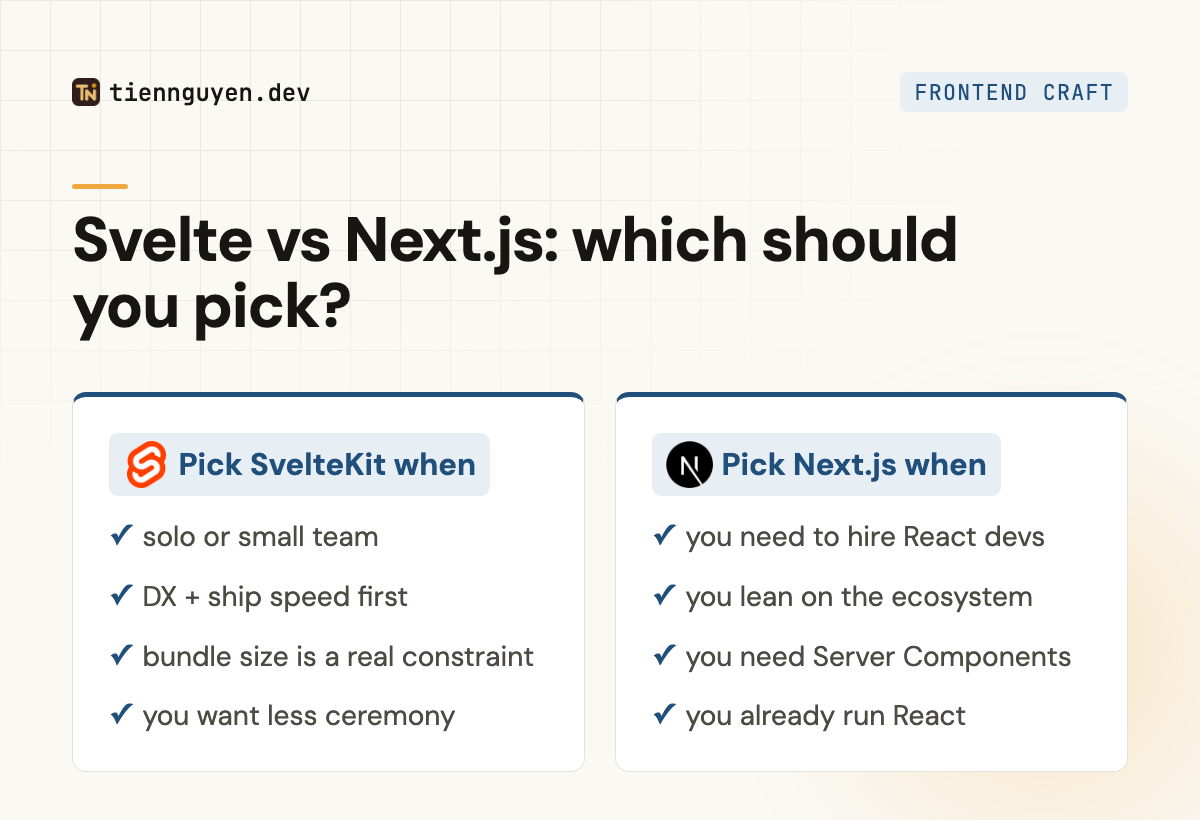
Pick SvelteKit when:
- You’re solo or on a small team that owns its whole stack.
- Developer experience and shipping speed matter more than ecosystem breadth.
- The bundle size is a real product constraint (content sites, embeds, slow-network audiences).
- You want less framework ceremony and reactivity that reads like plain JS.
Pick Next.js when:
- You need to hire, or you already have React engineers. This one usually wins on its own.
- You depend on a broad ecosystem (component libraries, auth, integrations) you don’t want to build.
- You actually need React Server Components and the streaming/data model around them.
- You’re already in the React world and the switching cost isn’t worth it.
Where each bites you: SvelteKit’s failure mode is reaching for a mature library that doesn’t exist yet, and building it yourself. Next.js’s failure mode is the App Router’s complexity tax: RSC boundaries, caching surprises, and a “why did this re-render on the server” afternoon.
SvelteKit vs Next.js at a glance
| SvelteKit | Next.js | |
|---|---|---|
| Built on | Svelte (compiler) | React (runtime) |
| Browser runtime | Minimal, no virtual DOM | React runtime + virtual DOM |
| Bundle size | Smaller, especially when small | Larger baseline |
| Reactivity | Runes ($state, $derived) | Hooks (useState, useEffect) |
| Learning curve | Gentler, less boilerplate | Steeper, more concepts |
| Server rendering | SSR / SSG built in | SSR / SSG + React Server Components |
| Ecosystem | Smaller, growing | Huge (all of React) |
| Hiring pool | Thin | Deep |
| Best for | Small teams, DX, perf-critical | Ecosystem, scale, hiring |
The takeaway
Comparing Svelte to Next.js compares the wrong things. The one to weigh against Next.js is SvelteKit. Once you do: SvelteKit is the framework I’d reach for on a solo build where I want to move fast and ship something small and quick. Next.js is the one I’d bet a team and a hiring plan on, because the ecosystem and the talent pool are the parts you can’t compile away.
If you’re one person optimizing for joy and bundle size, try SvelteKit. If you’re a team optimizing for hiring and not-reinventing-things, stay on Next.js. Both are excellent. The right answer is about your constraints, not the frameworks.
Frequently asked questions
Should I learn SvelteKit or Next.js?
If you want the widest job market and the biggest ecosystem, learn Next.js. It's the default React meta-framework, so the skills transfer to most front-end roles. If you're solo, care most about developer experience and small bundles, or you're building something perf-sensitive, SvelteKit is the more pleasant tool and you'll ship faster with less boilerplate.
Is Next.js still relevant in 2026?
Very. Next.js is still the dominant React meta-framework, with the largest ecosystem, the most component libraries, and by far the most jobs. The App Router and React Server Components added real complexity, but none of that made Next.js less relevant. For most teams it's still the safe default.
What are the disadvantages of Svelte and SvelteKit?
The framework itself is excellent. The disadvantages are around it: a smaller ecosystem (fewer mature component libraries and integrations), a thinner hiring pool, and a smaller community, so you hit unanswered edge cases more often. You trade a nicer day-to-day experience for less of a safety net when things get weird.
Is Svelte harder to learn than React?
No, it's usually easier. Svelte has less boilerplate and its reactivity (runes, in Svelte 5) reads closer to plain JavaScript than React's hooks and dependency arrays. The catch: React skills open far more doors, so "easier to learn" and "more useful to know" point in different directions.
Is SvelteKit production-ready?
Yes. SvelteKit has been stable (1.0+) for years and runs plenty of production sites. Its risk is ecosystem depth, not stability: you're more likely to have to build a piece yourself that you'd have installed off the shelf in the Next.js world.
Keep reading

Tien Nguyen
· 8 min read
SolidJS vs Svelte: same signals, different bet
SolidJS vs Svelte used to be compiler vs runtime. Svelte 5 runes made them both signals-based. Here's what actually differs now, and how to pick.
Read article
Tien Nguyen
· 7 min read
Is JavaScript hard to learn? The parts that actually are
Is JavaScript hard to learn? Easy to start, hard to master. The hard parts are specific (the event loop, this, closures, coercion), plus the AI-era catch.
Read article
Tien Nguyen
· 9 min read
React Query vs Redux: the wrong question, and the right one
React Query vs Redux is the wrong question: one is server state, one is client state. Plus the real fight (RQ vs RTK Query) and the pattern AI still writes.
Read articleLiked this? Let's build something.
I take on a small number of front end and AI-engineering projects, and I'm always up for talking shop. Tell me what you're working on.