
How to master React in 2026 (when AI writes the code)

Tien Nguyen
· 8 min read
Here’s what changed about mastering React, and almost nobody writing “how to master React” has caught up: AI now writes competent React for free. The components, the hooks, the boilerplate. The thing that used to take a year to get fluent at is a prompt away.
So mastery moved. It’s no longer “know more of the API.” It’s the judgment above the code: knowing why a component re-renders, where state should live, when not to use an effect, and how to spot the bug the model just confidently shipped. That judgment is the part AI can’t hand you, and it’s the whole game now.
For where I’m coming from: most of my production React time has gone into reviewing other people’s React, and lately a lot of AI’s. From that seat, mastery isn’t more syntax. It’s the small number of models that let you look at any component and know what it will do.

What does mastering React actually mean in 2026?
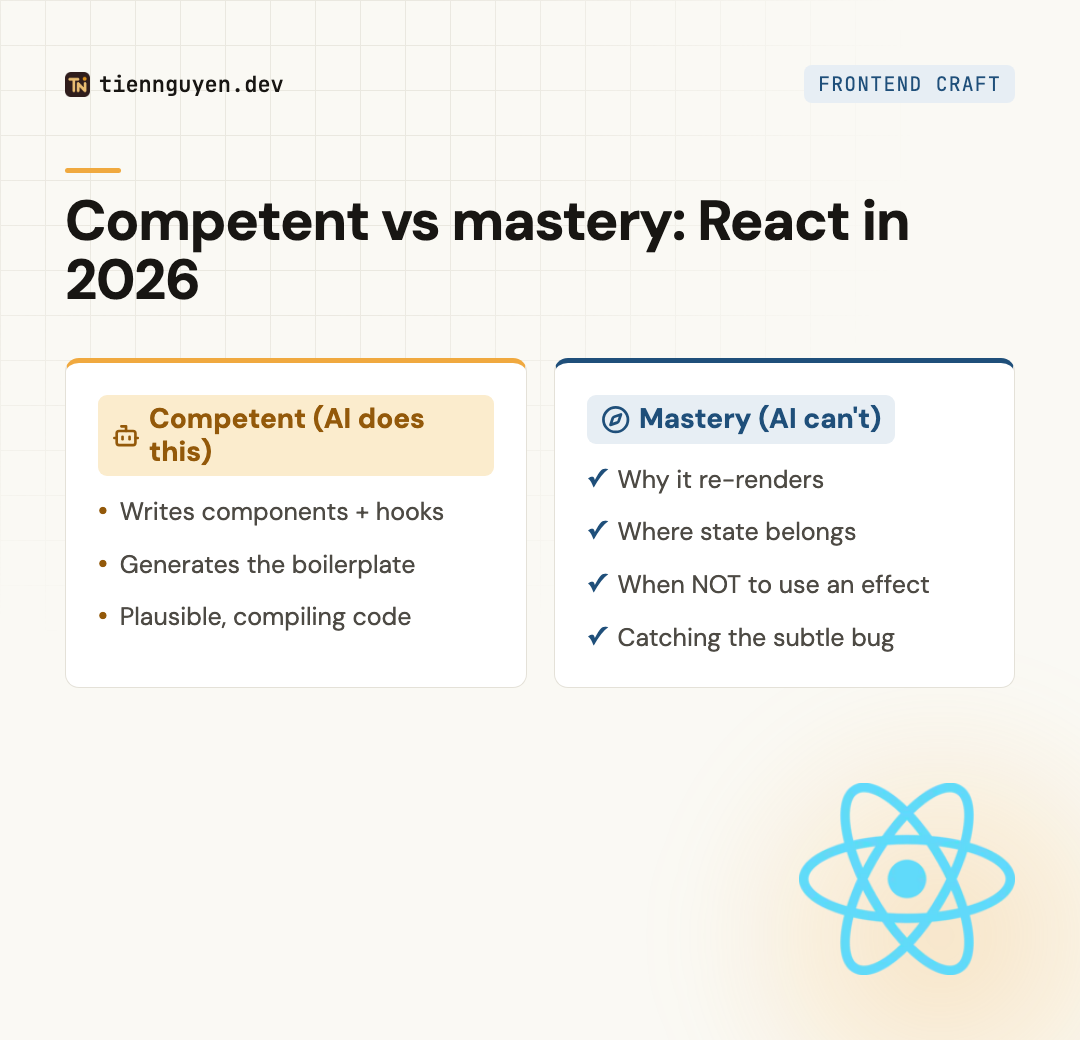
Not what the tutorials imply. Nobody masters React by learning more hooks. The masters I’ve worked with are separated from competent developers by a short list of deep models, not a long list of features:
| Competent (AI does this) | Mastery (the judgment AI can’t) | |
|---|---|---|
| Rendering | Writes components that render | Knows why they re-render, and what it costs |
| State | Calls useState | Knows where the state should live first |
| Effects | Reaches for useEffect | Knows when not to |
| Reviewing | Generates plausible code | Reads it and says why each line is right or wrong |
Everything in that right column is a section below. None of it is a new API to memorize.
Why does a React component re-render?
The render model is the foundation, and it’s the thing beginners never learn because their apps are too small to feel it. React re-renders a component when its state or props change, then reconciles the result against the previous render. Master when that happens and most “why is this slow / stale / flickering” mysteries evaporate.
Here’s a bug that separates the two levels. This memoized child re-renders on every parent render anyway:
const SearchBox = memo(function SearchBox({ onSearch }) {  return <input onChange={(e) => onSearch(e.target.value)} />;});
function Page() {  const [count, setCount] = useState(0);
  // a NEW function is created on every render of Page,  // so memo() sees a "changed" prop and re-renders SearchBox anyway:  const onSearch = (q) => runSearch(q);
  return (    <>      <button onClick={() => setCount(count + 1)}>{count}</button>      <SearchBox onSearch={onSearch} />    </>  );}
memo compares props by identity, and onSearch is a brand-new function each render, so the memoization does nothing. The classic fix is useCallback to keep the function’s identity stable:
const onSearch = useCallback((q) => runSearch(q), []);Here’s the 2026 twist a master has to hold: React now has a stable, opt-in compiler (a build plugin you enable, babel-plugin-react-compiler, that works with React 17 through 19) which auto-memoizes for you, so once it’s on, hand-written useCallback and useMemo are needed far less often than the tutorials say. That does not make the render model optional. It makes it more important: you still have to understand why the re-render happens to read what the compiler is doing and to catch the cases it can’t. Mastery is the model, not the workaround.
Where should React state live?
Beginners ask “how do I use state.” Masters ask “where does this state belong,” and answer it before writing a line. The ladder:
- Colocate. Keep state in the component that uses it. Most state never needs to move.
- Lift it to the closest common parent only when two components genuinely share it.
- Context for truly app-wide, rarely-changing values (theme, the current user), not as a general state bus.
- Reach for a store (Zustand, Redux Toolkit) only when client state is genuinely global and complex. That decision has real tradeoffs, which I break down in Zustand vs Redux.
The mistake that marks a non-master is skipping straight to step 4, reaching for a global store for state that three components share. Half of “React is a mess” is really state that was put in the wrong place.
When should you not use useEffect?
useEffect is the most overused hook in React, and restraint with it is one of the clearest mastery signals. Most of what beginners (and AI) put in effects doesn’t belong there: derived values should be computed during render, and server data belongs in a framework loader or a data library, not a hand-rolled fetch in useEffect. React’s own docs now have a page titled “You Might Not Need an Effect” for exactly this reason.
The related class of bug, the stale closure over a dependency array, shows up in AI output as often as it does in beginners’ code, and I walk through a concrete one in is React easy to learn. A master’s instinct is to ask “does this even need an effect?” first, and usually the answer is no.
The real 2026 skill: reviewing AI’s React
Here’s the skill that didn’t exist five years ago and now sits at the center of mastery: reading React you didn’t write, and catching what’s wrong with it. AI generates plausible React all day. Plausible is not correct, and the gap is exactly where mastery lives.
The bugs AI ships most are the ones above, precisely because they compile and look fine:
- Stale closures and wrong dependency arrays in effects.
- Avoidable re-renders from new object/function props each render.
- State in the wrong place, usually a global store for something local, or an effect syncing state that should have been derived.
useEffectused for things that aren’t effects at all.
None of these throw an error. They pass review from someone who only knows the syntax, and they get caught instantly by someone who understands the model. In 2026, mastering React largely is being that second person: the one who reads the generated code and knows, precisely, why a line is right or wrong.
Who gets paid more once AI writes the React?
The person who can tell whether the React is any good. React has a bigger install base than any other frontend framework, so there’s more AI-generated React in the world to review, architect, and fix than for anything else, and the judgment to do that well is the scarce part now. If you’re still building the base, the step-by-step path is here; this post is what comes after it.
Where mastery actually lives
Mastering React in 2026 isn’t a longer list of hooks. It’s a short list of deep models, the render model, state architecture, effect discipline, and the judgment to review code critically, that let you look at any component, yours or a model’s, and know what it does and what’s wrong with it.
AI made the syntax free and the judgment scarce. Master the judgment. That’s the part that was always the real work, and now it’s the only part that’s yours.
Frequently asked questions
Is React hard to master?
The basics are easy; mastery is hard, and it's a different kind of hard than beginners expect. It's not more API surface, it's judgment: understanding why components re-render, where state should live, when not to use an effect, and how to spot the subtle bugs that syntax knowledge alone won't catch. In 2026, that judgment is the whole game, because AI already handles the syntax.
How do I improve my React skills past the tutorials?
Stop collecting features and start building the model underneath. Learn how rendering and reconciliation actually work, practice deciding where state belongs, and get deliberate about when not to reach for an effect. The fastest way to level up in 2026 is to review code, including AI-generated code, and be able to say exactly why each line is right or wrong.
Is React still relevant in 2026?
Yes, and arguably more than before. React is still the default choice for new frontend work and the base most meta-frameworks build on, so demand for it is steady. What changed is that AI now writes a lot of it, which shifts the value from typing React to judging it. The people who can read a generated component and tell whether it's right are the ones in demand. Relevance was never the question; the skill that matters within it moved.
Can I learn React in 7 days?
You can learn the basics in about a week if your JavaScript is solid. You cannot master React in 7 days, or 7 weeks. Real mastery is 6 to 12 months of building and reviewing actual projects, then years of hitting enough sharp edges to see them coming. Anyone promising mastery in a week is selling the easy first week and skipping everything that makes React hard.
Keep reading
Tien Nguyen
· 7 min read
How to learn React in 2026: the AI-first roadmap
How to learn React in 2026: a step-by-step AI-first roadmap. The JavaScript to learn first, what to build, and how to use AI as a tutor without faking it.
Read article
Tien Nguyen
· 8 min read
Is React easy to learn? An honest 2026 answer
Is React easy to learn? Yes to start, hard to master, and AI changed the curve. The honest answer, the JavaScript you need first, and how to learn it in 2026.
Read article
Tien Nguyen
· 9 min read
React Query vs Redux: the wrong question, and the right one
React Query vs Redux is the wrong question: one is server state, one is client state. Plus the real fight (RQ vs RTK Query) and the pattern AI still writes.
Read articleLiked this? Let's build something.
I take on a small number of front end and AI-engineering projects, and I'm always up for talking shop. Tell me what you're working on.